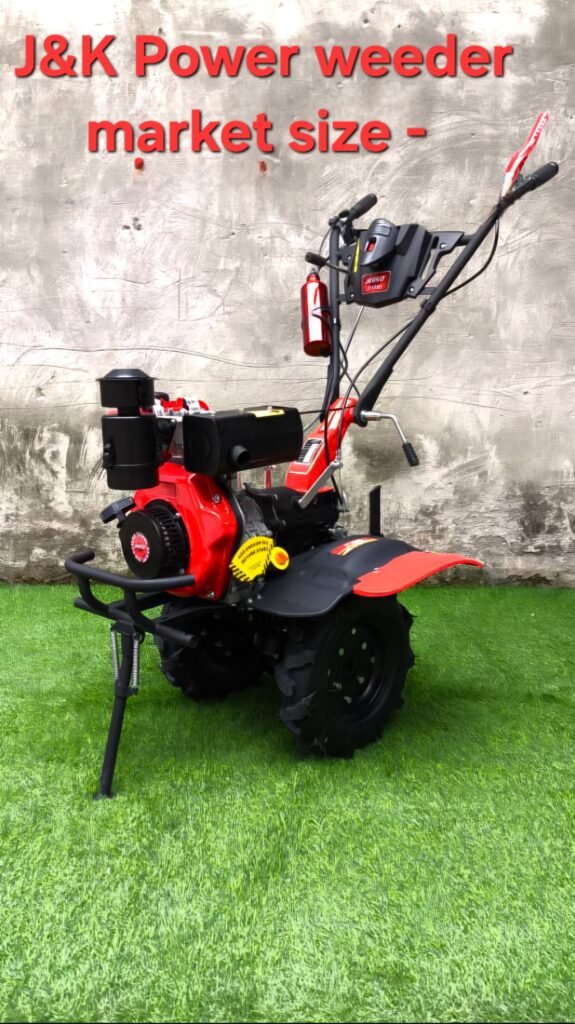
Jammu & Kashmir has emerged as an attractive 20,000+ unit power weeder opportunity, driven by rapid horticulture expansion, subsidy support and a strong but largely import-dependent dealer network.Market size and demand drivers.The estimated industry size of over 20,000 power weeders in the UT is realistic when mapped against the scale of apple, saffron, walnut and vegetable cultivation that now dominates many districts.
High-density apple plantations in Pulwama, Sophian, Baramulla and adjoining belts alone have converted hundreds of hectares in recent years, sharply boosting demand for compact mechanisation solutions for inter-row operations where tractors cannot enter.
Across the UT, over 270 dealers and sub-dealers is a reasonable working estimate when aggregating exclusive outlets, multi-brand agri centres, and motor/agro shops that now stock weeders along.Brand mix, imports and pricing behaviour.
The J&K power weeder market is overwhelmingly import-dominated, with 99%+ volume coming from Chinese and other imported platforms rebadged under local and regional brands, especially in the 5–9 hp petrol category.
These products position on aggressive pricing, often in the ₹25,000–₹40,000 range, supported by channel partners who push fast-moving models with attractive dealer margins.
Alongside this, a strong branded layer exists: Honda, Simpson, Shrachi, VST, Husqvarna, Stihl, Kirloskar and others are present through authorised dealers in Srinagar, Udhampur, Kupwara and Jammu, often combining power tillers and power weeders in their portfolio.These brands differentiate with better engine quality, parts availability and formal warranty, appealing to progressive orchardists in apple hubs who view mechanisation as a long-term investment rather than a one-season experiment.
Power weeders selling majorly dealers:
1. Dar tillers – Sopore
2. Pakiza motors – Magam
3. JK krishi – Srinagar
4. Wani agricultiure – Sopore
5. Swastik agro – Jammu
6. Dass agro – Pulwama
7. Zargar – Kulgam
8. KFC – Sopore
9. JK Tools – Sophian
10. Iqbal Agencies – Baramulla
The primary agronomic drivers for power weeders in J&K are:
Apple: traditional and high-density orchards requiring frequent weeding and soil loosening between rows.
Saffron and vegetables: labour-intensive intercultivation where farmers seek to cut labour cost and time.Walnuts and mixed fruit: small and fragmented orchards in hilly terrain where lightweight machines are preferred over full-size tractors.
Key product segments (HP wise)
The market is dominated by three broad segments aligned to field and crop conditions:
5 hp petrol weeders: used by small and marginal farmers in vegetables and light intercultivation; attractive because of lower initial price and easier handling.
7 hp petrol weeders: the volume driver segment for medium orchards and vegetable fields, balancing power, weight and cost; many multi-brand dealers.
9 hp diesel / mini tiller class: used for heavier soils, apple orchards on slopes and semi-commercial operations; overlaps functionally with “power tiller below 8 BHP / around 8–9 hp” category recognised in government mechanisation.
Government horticulture mechanisation guidelines clearly list “power tiller below 8 BHP” with 50% subsidy and “power tiller 8 BHP and above” with higher ceilings, which effectively covers many 7–9 hp power weeders and small tillers when configured with rotary attachments.
Subsidy ecosystem and active departments:Two departments are central for subsidy-led demand:
Horticulture Department: Under horticulture mechanisation, farmers receive support on power tillers/mini-tractors used in orchards, with substantial subsidy percentages for small and marginal growers, particularly in apple orchards.
Agriculture Department: Through schemes such as SMAM and Macro Management / RKVY, the Agriculture Department supports farm mechanisation including power tillers and weeding equipment, making power weeders accessible to open-field vegetable and saffron growers.Geography and dealer network.
Sales are heavily skewed toward high-value horticulture and vegetable districts in Kashmir valley.
Like : Pulwama, Anantnag, Kulgam, Shopian, Baramulla and pockets like Magam have become natural hotspots due to concentration of high-density apples, traditional orchards and vegetables.
Dealer directories show a dense presence of power weeder and tiller outlets in Srinagar, Jammu, Udhampur, Kupwara and other nodes, with many dealers catering to surrounding rural belts through sub-dealers and village-level influencers.
Overall, the J&K power weeder industry is transitioning from pure price-play imports to a more structured, subsidy-driven and brand-conscious market anchored in the rapidly modernising apple and horticulture economy of the valley.